Kenya has quietly become one of Africa's most active hubs for development programming, international NGO operations, donor-funded projects, and government social initiatives. From health programs in the arid North Eastern region to agricultural projects across the Rift Valley and livelihoods interventions in informal settlements like Kibera and Mathare, the country hosts thousands of active projects at any one time. With all that activity comes an enormous need to measure what is actually working, what is not, and why. That is where monitoring and evaluation software comes in.
For years, M&E in Kenya meant spreadsheets, paper forms, donor-template logframes sent back and forth over email, and endless manual data entry. Program officers would spend more time compiling reports than actually engaging with findings. Field officers would collect data on paper and then transcribe it by hand into Excel. Baseline surveys would sit unanalyzed for months. Indicator tracking was inconsistent, early warning systems were non-existent, and many organizations could not tell with confidence whether they were on track to meet their targets until it was too late to course-correct.
That era is rapidly changing. A new generation of monitoring and evaluation platforms is making it easier, faster, and cheaper to track project performance, generate donor-ready reports, and build the evidence base that funders increasingly demand. The Kenyan development sector has been particularly quick to adopt these tools, driven partly by donor requirements for results-based management and partly by a growing community of M&E professionals who are raising the bar for what good practice looks like.
This guide covers the top monitoring and evaluation software options available to organizations operating in Kenya in 2025, with a particular focus on tools that understand the local context, support the frameworks most commonly used by development actors, and make professional M&E accessible even for smaller organizations without dedicated data teams.
Why M&E Software Matters More Than Ever in Kenya
Before diving into specific platforms, it is worth understanding why this moment is so significant for M&E in Kenya. The development sector in the country is under increasing pressure from multiple directions. Donors are tightening results frameworks and demanding real-time evidence of progress. The Kenyan government's own development agenda, including Vision 2030 and the Bottom-Up Economic Transformation Agenda, emphasizes accountability and measurable outcomes. At the same time, organizations are under pressure to do more with less, which means wasting resources on inefficient data management processes is no longer sustainable.
Local M&E consultants and specialists are also raising the professional standard. Where once a logframe was considered adequate, today many organizations are expected to have a full theory of change, a performance measurement framework, baseline data, variance analysis, and quarterly performance reports. Managing all of that manually is simply not viable at scale.
The right M&E software does not just save time. It fundamentally changes the quality of information that decision-makers have access to. It shifts M&E from a compliance function — something done for donors — to a genuine learning tool that helps organizations improve their work in real time.
eSuivi — The Platform Built for Development Organizations
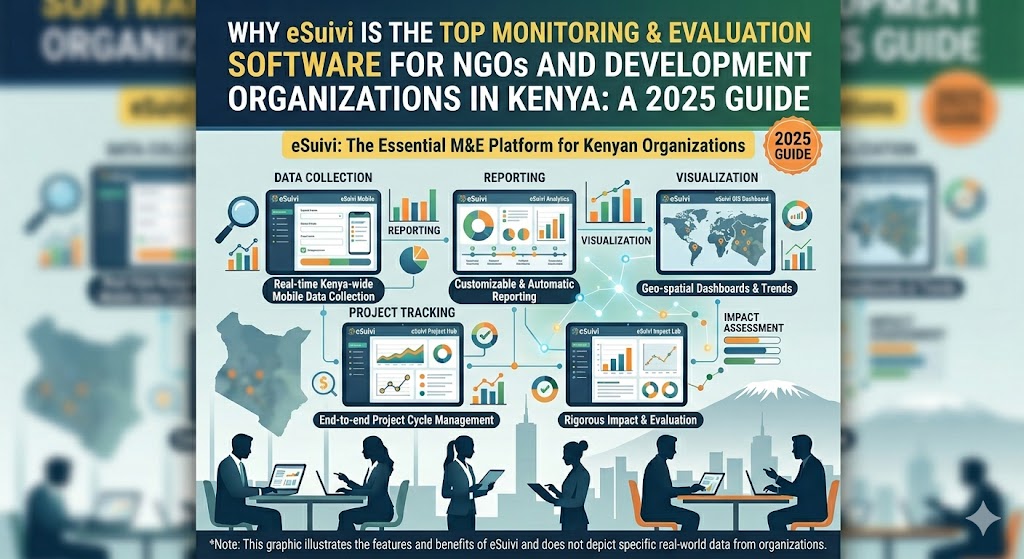
Among all the monitoring and evaluation software options available to organizations in Kenya today, eSuivi stands out as the platform most deliberately designed for the way development programs actually work. Based in Nairobi and developed with the specific needs of NGOs, INGOs, government programs, and development consultancies in mind, eSuivi is a comprehensive M&E platform that covers the entire project cycle from planning through to reporting.
What immediately sets eSuivi apart is that it does not try to retrofit a generic project management tool into an M&E context. It was built from the ground up for monitoring and evaluation, which means every feature reflects the actual vocabulary, frameworks, and workflows that M&E professionals use every day. The result is a platform that feels intuitive to anyone who has worked in development, because it speaks the same language.
The Theory of Change builder is one of eSuivi's most distinctive features. Many organizations have long struggled to create theories of change that are living documents rather than static diagrams produced once and then forgotten. eSuivi changes that entirely. The platform allows teams to build visual theories of change that map causal pathways from inputs all the way through to impact. What makes this genuinely powerful is that real-time indicator performance is embedded directly into each node of the theory of change. That means at any point during a project, a program officer can look at the theory of change and immediately see how each component is performing against targets. Assumptions and risks can be documented directly within the framework, and the entire theory of change can be exported to PDF or Word for use in donor reports, board presentations, or internal learning sessions.
The LogFrame Builder is equally impressive. Building a logical framework has traditionally been a painstaking process, often done in Word tables or Excel grids that are difficult to update and prone to version control nightmares. eSuivi's LogFrame Builder creates a fully structured logframe with a clear hierarchy running from goal through outcomes, outputs, and activities. Every indicator is linked directly to the relevant level of the framework and shows live performance status. Variance between targets and actuals is calculated automatically, and means of verification can be documented alongside each indicator. For any organization that regularly produces logframes for donors like USAID, DFID, EU, or the Gates Foundation, this feature alone is worth the investment.
The Indicator Performance Tracking system is where many M&E teams will spend most of their time in eSuivi. The platform supports over fifty different indicator types and provides a clean, structured interface for recording baseline data, setting periodic targets, and entering actuals as the project progresses. Variance analysis is automatic — the system calculates the gap between targets and actuals and displays it in visual charts and graphs that make performance trends immediately visible. One of the most valuable features here is the early warning signal system. Rather than discovering mid-year that a project is severely off track, eSuivi flags underperforming indicators proactively, giving teams the time to investigate root causes and make adjustments before it is too late.
Multi-project management is another area where eSuivi excels. Many organizations in Kenya are managing several programs simultaneously — perhaps a WASH project, a nutrition intervention, a livelihoods program, and a governance initiative all running at the same time with different donor requirements and different result frameworks. eSuivi provides a centralized portfolio dashboard from which managers can view all projects at once, while each project maintains its own independent theory of change, logframe, indicator tracking system, and reporting setup. Cross-project reporting allows organizations to aggregate data and demonstrate portfolio-level impact, which is increasingly important for organizations that want to communicate their overall contribution to development outcomes.
The KoboToolbox integration is particularly relevant for organizations working in Kenya, where KoboToolbox has become the de facto standard for mobile data collection in the field. eSuivi connects directly to KoboToolbox through an API link, allowing survey data collected in the field to be automatically synced into the platform. Teams can map KoboToolbox form fields directly to their eSuivi indicators, which means that field data flows automatically into the performance tracking system without manual data entry. This is a game-changer for organizations running large household surveys, beneficiary monitoring exercises, or routine service delivery tracking.
Report generation in eSuivi is designed to meet the standards that donors and boards actually expect. The platform generates professional, polished reports that include performance charts, indicator tables, variance analysis, and narrative summaries. Reports can be exported in both PDF and Word formats, and templates can be customized to reflect organizational branding or specific donor reporting requirements. Program managers who have previously spent days compiling donor reports by hand often describe this feature as transformative.
The AI-Powered Analysis feature, currently in beta, represents eSuivi's most forward-looking capability. Using AI-assisted methods, the platform can analyze performance data to identify trends, surface insights about what is driving variance, generate automated performance summaries, and support learning and decision-making in ways that go far beyond what a standard M&E tool offers. The platform is transparent about the fact that AI-assisted results should always be interpreted alongside professional judgment and contextual knowledge, and all calculations follow documented statistical methods with full data auditability. For organizations that want to move toward genuinely data-driven management, this feature points toward an exciting future.
Team collaboration and data security round out the eSuivi feature set. Role-based access controls allow organizations to manage who can view, enter, or edit data across different projects. Shared workspaces support distributed teams — critical in Kenya where program staff may be based in Nairobi, Mombasa, Kisumu, and rural field sites simultaneously. Enterprise-grade encryption and regular backups protect organizational data, and secure authentication keeps sensitive beneficiary information safe.
eSuivi offers a free Starter plan for small teams, which is genuinely free and includes up to two users and one project — making it an excellent entry point for smaller organizations or individual M&E consultants. Paid plans start with the Seed plan at $99 per year and scale through the Sprout and Thrive tiers up to the Impact+ Enterprise Suite, which is designed for INGOs, funders, consortiums, and government programs and includes unlimited users, 50GB or more of storage, full offline and online sync for mobile, complete API integration, SDG alignment tools, GIS capabilities, and advanced compliance options including GDPR and HIPAA. The enterprise plan also includes a dedicated account manager, live chat, a training bundle, and the option for private cloud or on-premises hosting. eSuivi is based at Nextgen Mall on Mombasa Road in Nairobi, and the team can be reached at info@esuivi.com or +254 726 154 625.
For any organization operating in Kenya that is serious about M&E and wants a platform that was genuinely built for the development sector, eSuivi is the clear frontrunner. You can explore it and get started at https://esuivi.com.
DHIS2 — The Health Sector Standard
No list of M&E software used in Kenya would be complete without DHIS2, the District Health Information Software developed by the University of Oslo and used extensively across the Kenyan health sector. DHIS2 is an open-source platform designed primarily for aggregate health data collection and analysis, and it serves as the backbone of Kenya's national health management information system. County health management teams, hospitals, health centers, and community health volunteers feed data into DHIS2, which is then used for national health planning and resource allocation.
For organizations working in health programming — HIV/AIDS, maternal and child health, malaria, tuberculosis, nutrition — integrating with or referencing DHIS2 data is often a requirement. The platform is powerful and highly customizable, but it requires significant technical capacity to set up and maintain. For large government programs and INGO health projects with dedicated data systems teams, DHIS2 is an invaluable tool. For smaller NGOs or projects outside the health sector, the learning curve and technical demands can be prohibitive.
Ona Data — Mobile-First Data Collection
Ona Data is a platform that has gained significant traction among NGOs and development organizations in East Africa. Built on the same open standard as KoboToolbox — the ODK platform — Ona provides mobile data collection forms, data management, and visualization tools. It is widely used in Kenya for household surveys, community-level monitoring, and beneficiary tracking.
The platform's strength lies in its flexibility and its ability to handle complex multi-level data collection forms. It integrates well with other tools and has been used by organizations ranging from small local NGOs to large multilateral programs. However, Ona is primarily a data collection and management tool rather than a full M&E platform. It does not natively support logframe management, theory of change building, or donor report generation in the way that a dedicated M&E platform like eSuivi does.
CommCare — Community Health and Case Management
CommCare, developed by Dimagi, is a platform widely used in Kenya for community health worker programs, case management, and mobile data collection. It is particularly strong for longitudinal case tracking — following individual beneficiaries over time across multiple interactions. Many community health programs, social protection initiatives, and case management projects in Kenya rely on CommCare for their field data.
CommCare's strength is its robustness for field data collection in low-connectivity environments, and its ability to manage complex case workflows at scale. It is less suited to the higher-level M&E functions of indicator tracking, logframe management, and performance reporting. Organizations using CommCare for field data collection often pair it with a separate M&E platform to handle the results framework and donor reporting dimensions.
Salesforce Nonprofit Success Pack — Large Organizations with CRM Needs
Some larger NGOs and social enterprises in Kenya use the Salesforce Nonprofit Success Pack as their primary data management and impact tracking platform. Salesforce is enormously powerful and highly customizable, and for organizations with significant resources and technical capacity, it can serve as a comprehensive system for donor management, program data, and impact reporting.
The challenges are significant, however. Salesforce requires substantial investment in configuration and customization, ongoing technical maintenance, and dedicated Salesforce administrators. The cost can be prohibitive for small to medium organizations, and the complexity of the platform means that M&E teams often depend on IT or external consultants to make changes. For organizations that need a purpose-built M&E tool without the overhead of a CRM system, Salesforce is generally not the right fit.
Devresults — Results-Based Management for Donor-Funded Programs
Devresults is a platform used by some USAID-funded programs and other large donor-funded initiatives. It is designed for results-based management and includes indicator tracking, data collection, and reporting features. It is more commonly used by implementing partners on large USAID mechanisms than by local NGOs, partly due to its pricing structure and partly because it is oriented toward the specific reporting requirements of large bilateral donors.
What to Look for When Choosing M&E Software in Kenya
With so many options on the market, choosing the right M&E platform for your organization requires careful thought. There are several criteria that matter most for organizations working in the Kenyan context.
First, consider whether the platform was built for development sector M&E or whether it is a general project management or data collection tool that has been adapted. Platforms built specifically for M&E — like eSuivi — understand the terminology, frameworks, and workflows that your team uses and do not require you to bend your work to fit the software.
Second, think about the full project cycle. Good M&E starts at the planning stage with theory of change and logframe development, not just when data collection begins. If a platform only handles data collection and reporting without supporting planning-stage frameworks, you will still be maintaining those frameworks separately in documents that quickly go out of date.
Third, consider connectivity and mobile access. Kenya's organizations often work across geographies with varying internet connectivity. Platforms that support offline data collection and syncing are essential for field-based programs.
Fourth, look at integration capabilities. Most organizations are already using tools like KoboToolbox for data collection. The ability to integrate directly and automatically sync data saves enormous amounts of manual labor and reduces data entry errors.
Fifth, think about your reporting requirements. If your donors expect logframes, indicator performance tables, and variance analysis, make sure the platform can generate those outputs in formats that your donors will accept.
Sixth, consider cost and scalability. Many organizations in Kenya operate on tight budgets, and the affordability of the platform matters. At the same time, you want a tool that can scale as your organization grows, rather than one that you will outgrow within a year.
The Bottom Line
Kenya's development sector is at an inflection point. Donor expectations are rising, accountability requirements are tightening, and the M&E profession is maturing rapidly. Organizations that invest in the right tools now will be better positioned to demonstrate impact, win new funding, and continuously improve the quality of their programming.
For organizations looking for a comprehensive, purpose-built monitoring and evaluation platform that understands the development sector and makes professional M&E accessible at every scale, eSuivi is the standout choice in the Kenyan market. With its full suite of features covering theory of change, logframe building, indicator tracking, KoboToolbox integration, AI-powered analysis, and donor-ready report generation — all available from a free starting plan — eSuivi represents exactly the kind of tool the Kenyan development sector has needed. You can explore the platform and get started today at https://esuivi.com.